A test of which simulation?
If a world were built on a cubic grid, the grid could favor certain directions. At extreme energies the sky might show that preference. Other ways of building a world would leave no such scar. A test always tests a model.
If a world were built on a cubic grid, the grid could favor certain directions. At everyday energies the cube would hide. At extreme energies, the sky of the highest-energy cosmic rays might reveal that preference.
The law
The cube
A cubic grid of spacetime. At long wavelengths it looks smooth, the way a crystal looks even to a long wave.
Later named: Lorentz invariance
The break
The axes
If the grid sits still in space, some directions are special. The cube has preferred lines.
Later named: preferred rest frame
The search
The sky
The highest-energy arrivals might remember those lines. That would be a scar of this implementation. Not of every implementation.
Later named: cosmic-ray anisotropy
Failure to see a cube is not a proof we are base reality. It is a constraint on one way of building a world.
A test always tests an implementation. Move the lattice spacing. Watch the sky of the highest-energy arrivals. Failure to see a cube does not rule out every simulation.
Energy, log₁₀(GeV)
eV to Planck
A lattice test lives on this ruler. Move the inverse spacing. The cursor is the cutoff you assumed. The GZK end of the cosmic-ray spectrum is the observation. Visible light and the LHC are here so the jump in scale is visible.
10⁻⁹ GeV10¹⁹ GeVLive ~10¹¹ GeV
Live 10¹¹ GeV
Visible2 eV
LHC1.4×10⁴ GeV
GZK6×10¹⁰ GeV
Planck1.2×10¹⁹ GeV
Scale notes
Visible
2 eV
Green light. Chemistry lives here.
LHC
1.4×10⁴ GeV
13.6 TeV proton collisions. The highest energy we make on Earth.
GZK
6×10¹⁰ GeV
Greisen–Zatsepin–Kuzmin cutoff. ~6×10¹⁹ eV. The cosmic-ray spectrum ends near here.
Beane
10¹¹ GeV
Inverse lattice spacing bound if the cube itself supplied that cutoff.
GUT
10¹⁶ GeV
Grand unification, as often quoted. Not a measurement of a simulator.
Planck
1.2×10¹⁹ GeV
Where gravity and quantum meet. The Planck length is not, by itself, a pixel.
The Beane, Davoudi, Savage bound. Look at the highest-energy arrivals. Not a detection. A search.
Assumed substrate
Cubic lattice
They ask what the world would look like if it were implemented on a cubic spacetime lattice, of the kind used in lattice quantum chromodynamics.
Predicted signature
Broken rotation
In that model, rotational symmetry can break at ultra-high energy. Cosmic rays might then prefer the axes of the lattice.
Observation
This sky
Ultra-high-energy cosmic rays might prefer the axes of the lattice. That is a search, not a detection.
Failure to see a cubic-lattice signature does not rule out every imaginable simulation.
This paper is not a detection of a simulation. It is a constraint on one implementation.
The most stringent bound Beane, Davoudi and Savage quote on the inverse lattice spacing of a cubic implementation, from the high-energy cutoff of the cosmic ray spectrum. If the lattice itself supplied that cutoff, the highest-energy arrival directions would remember the cube.
Silas R. Beane, Zohreh Davoudi, and Martin J. Savage, “Constraints on the Universe as a Numerical Simulation,” European Physical Journal A 50, no. 148 (2014).
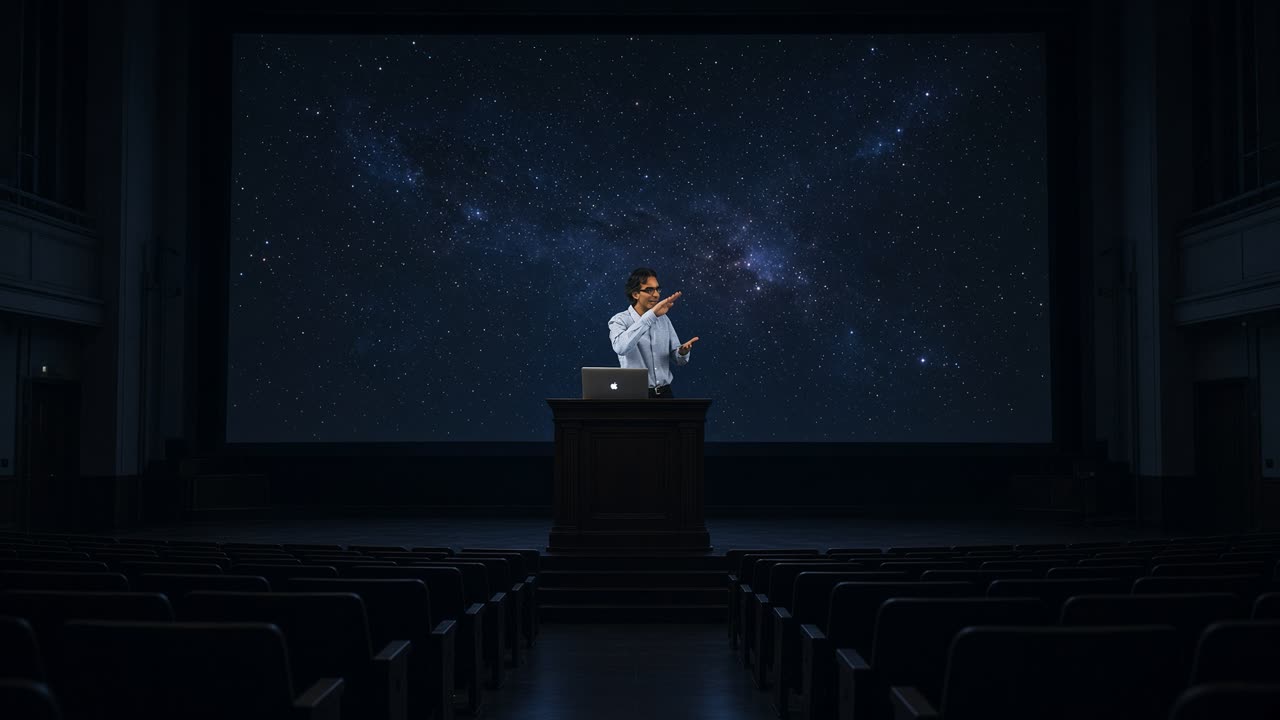
After the picture, hear the physicist who wrote the test. A cubic grid, not every possible simulated world.
A cubic grid would leave a scar in the cosmic-ray sky.
Silas BeaneSETI Institute colloquium23 September 201431:23
Source notes
Assume an underlying grid. A maximum momentum is imposed by the grid. The highest-energy cosmic rays could show that preferred direction.
A test of one implementation: a cubic lattice like the ones lattice QCD already uses. Official SETI colloquium on the 2014 paper.
Not a test of every simulation. Not a detection. A signature that would appear if this world were that kind of grid.
Official SETI Institute lecture. Start 31:23, the grid assumption.
Computable is not computed. A bound on this universe as a computer is not a detection of a computer outside it. Wolfram, asked what computer a computational universe would run on, answered: none.
Cubic lattice
The Beane, Davoudi, Savage model. Discrete spacetime of the kind used in lattice QCD. It can leave an anisotropy at ultra-high energy.
Seth Lloyd · 2002
10¹²⁰
ops
What it bounds
A bound on how much this universe, as a physical system, could have computed since the big bang.
What it does not mean
Not ancestor simulations. Not a programmer. Not Bostrom’s trilemma. A universe that computes is not automatically a universe someone is playing.
Seth Lloyd, “Computational Capacity of the Universe,” Physical Review Letters 88, no. 237901 (2002).
10⁹⁰ bits in matter; 10¹²⁰ if gravity is counted.
These are not tests
The Planck length is a pixel.
A smallest length in our physics is a cutoff, not a raster. Nothing in that bound requires a screen, a renderer, or a player.
The double-slit experiment is a render call.
Interference is a physical process. Collapse-talk in textbooks is not a camera looking, and not a game engine drawing the scene when you peek.
Quantum observation implies a player.
Observer in physics is a role in an experiment. It is not a gamer, and it is not proof that someone is watching us.
Holography is computer code.
A bound on how much information a region can hold is not source code. A hologram is not a hard drive with a programmer.
Fine tuning is a programmer’s signature.
Constants being peculiar is a live problem in physics. Peculiar is not a watermark. Other explanations compete, including chance and selection.
Lloyd’s 10¹²⁰ operations means someone is running us.
It is a bound on this universe as a physical system. A universe that can compute is not automatically a universe someone is playing.
Spoken · Physics
First public statement of each physical claim, from the beginning. Restatements collapse under the first. Interviews stay on Dates.
2017
The singularity for this level of the simulation is coming soon. I wonder what the levels above us look like.
5 October 2017speculationOpen the post
Nested simulators do not identify a last machine, or which level you are on. Depth is not a signature. The cheapest stack would not have to look like this physics unless it was built to.
2021
Another way of saying we’re in a simulation
26 October 2021inferenceOpen the post
A remark on whether real numbers can be physically instantiated. Mathematical is not simulated. A limit on continuum quantities is not a programmer.
2021
All of reality can be simulated with ones & zeroes
27 December 2021philosophical premiseOpen the post
Computable is not computed. Digital physics is not an ancestor-simulation. Wolfram’s own answer to what computer a computational universe would run on is none.
2021
The resolution of the universe is not smaller than Planck length
27 December 2021inferenceOpen the post
The Planck length is the scale where a photon’s wavelength would make a black hole. That is a scale of our ignorance, not a measured pixel. No experiment has shown spacetime has a cubic resolution.
2025
A Planck cube is the voxel size of the simulation
2 November 2025inferenceOpen the post
The 2021 resolution line, now named as a voxel. The Planck length is still not, by itself, a pixel. Discrete is not cubic. Cubic is not simulated.
2026
This perfectly matches simulation theory. Objects in a video game are only rendered when observed and there is a minimum voxel size.
13 March 2026inferenceOpen the post
In physics, observation is interaction, not a player looking. Quantum measurement is not a render call. A minimum length, if it exists, need not be a graphics optimization.
Restated 9 July 2026
Later statement of the same claim, not a new one. Open the later statement
2026
The universe is fundamentally integer. There are a finite number of Planck cubes, which means a limited number of digits of pi to calculate volume.
14 March 2026speculationOpen the post
David Deutsch, in reply: it may or may not be discrete, and there is no reason to suppose discreteness at the Planck distance any more than at the Planck mass. Volume of the universe is not a known finite integer. Trajectories use pi as analysis, not as a voxel budget.
Restated 29–30 August 2026
Later statement of the same claim, not a new one. Open the later statement